The Moments You Probably Rush Through
Most couples put enormous energy into the big things — date nights, anniversaries, hard conversations. But research on relationship satisfaction keeps pointing somewhere more ordinary: the doorway. The moment someone leaves for work. The moment they come home. These transition rituals — the hellos and goodbyes of daily life — turn out to matter far more than we tend to give them credit for.
This isn't about grand romantic gestures. It's about the ten seconds you spend actually stopping when your partner walks through the door.
Why Transitions Hit Different
Psychologist John Gottman's research found that couples who maintained what he called a meaningful departure ritual — even something as brief as a real, unhurried kiss goodbye — reported higher relationship satisfaction over time. The reason isn't magical. It's neurological.
Transitions are moments when our nervous system is already shifting gears. We're leaving one context and entering another. When a partner is present in that moment — genuinely, even briefly — it registers as you matter to me right now, not just in theory. When the transition is ignored (a distracted wave, a shout from another room), the message the brain quietly absorbs is the opposite.
Over months and years, those small signals accumulate into a felt sense of the relationship.
The Six-Second Goodbye
Gottman's team specifically studied the six-second kiss — a goodbye kiss long enough that it can't be entirely absent-minded. Six seconds is longer than you think when you try it. It requires you to actually pause.
You don't have to use exactly six seconds. The principle is this: make your goodbye intentional enough that it couldn't happen on autopilot. That might be a real embrace, a specific "I love you" with eye contact, or a brief "what are you hoping for today?" — something that acknowledges the other person as a person, not just a fixture in your morning.
Try this tomorrow: before whoever leaves first walks out the door, stop moving for just a moment. Make eye contact. Say something that's actually for them.
The Re-Entry Window
The return home is just as important — and often more fraught. One or both of you is carrying the residue of the day. Stress hormones don't evaporate at the threshold.
Research on stress crossover shows that one partner's cortisol levels reliably influence the other's within minutes of being in the same space. This means the quality of your re-entry — those first five to ten minutes home — can either help both of you decompress, or amplify the tension you each walked in with.
A useful practice: agree on a buffer ritual for re-entry. This could be as simple as:
- A genuine greeting before anyone checks their phone
- A five-minute rule where neither person launches into logistics or complaints right away
- A brief physical reconnection — a hug that lasts long enough to actually feel like a hug
The goal isn't to pretend hard days didn't happen. It's to establish, physically and emotionally, that you're glad the other person is home before you do anything else.
Making It Yours (Not a Script)
The mistake couples sometimes make is borrowing someone else's ritual wholesale — the prescribed kiss, the set phrase — and wondering why it feels hollow. Rituals only work when they're specific to you.
Think about what actually signals warmth and presence to your partner. For some people it's physical touch; for others it's being asked one genuine question; for others it's simply having their arrival acknowledged before the to-do list begins. If you're not sure, ask. "What would make it feel better when I come home?" is one of the most useful questions you can put into a relationship.
Then, and this is key, keep it simple enough that you'll actually do it on hard days. A ritual that requires energy or mood to execute isn't a ritual — it's a special occasion. The value of a transition ritual is precisely that it happens even when you're tired, even when the day was difficult, even when you're mildly annoyed at each other.
The Accumulation Principle
None of this is dramatic. That's the point.
A six-second goodbye takes less time than scrolling past three social media posts. A genuine greeting at the door costs almost nothing. But done consistently — not perfectly, just consistently — these moments build what researchers call felt security: the background sense that your relationship is a safe place, that your partner sees you, that you're not navigating life as two strangers sharing a calendar.
Big relationship problems rarely start as big problems. They usually begin in the slow erosion of small moments that didn't feel important at the time.
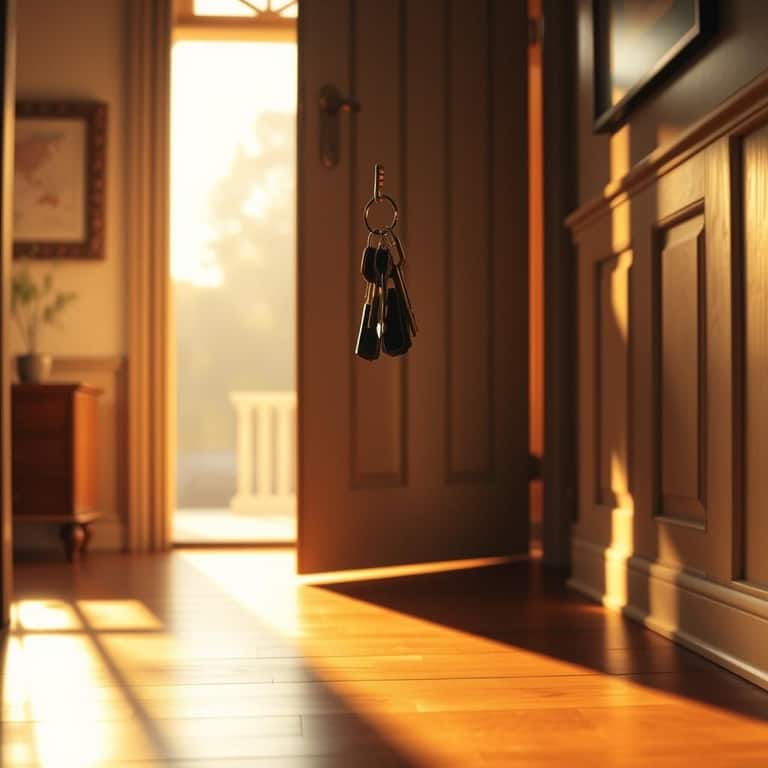
So tomorrow morning, when one of you reaches for the door handle — pause. Six seconds. Eye contact. Something true.
That's it. That's the whole practice.

